

U.S. House Replacement Patterns and the Accumulation of Institutional Authority
This Worked Example examines historical patterns of congressional replacement in the U.S. House of Representatives using empirical data on voluntary exit, electoral defeat, and reelection success. It illustrates how declining replacement extended tenure, altered authority distribution, and created the structural conditions under which seniority emerged.
These patterns are drawn from Congressional Research Service (CRS) analysis of historical congressional service data. Figures referenced include historical rates of members not seeking reelection and members defeated in reelection contests across congressional sessions.
They provide a factual basis for evaluating how replacement operates within electoral systems over time and clarify how changes in exit and defeat rates correspond to changes in tenure and the accumulation of institutional authority.
This analysis focuses on the U.S. House of Representatives, where uniform election cycles allow consistent measurement of replacement over time.
Exit and Defeat Channels in Congressional Tenure
Replacement in the U.S. House of Representatives occurs through two observable channels:
Exit (E): the percentage of members who do not seek reelection
Defeat (D): the percentage of members who seek reelection but are not returned to office
Together, these channels determine the rate at which officeholders are replaced and describe how membership changes across successive election cycles.
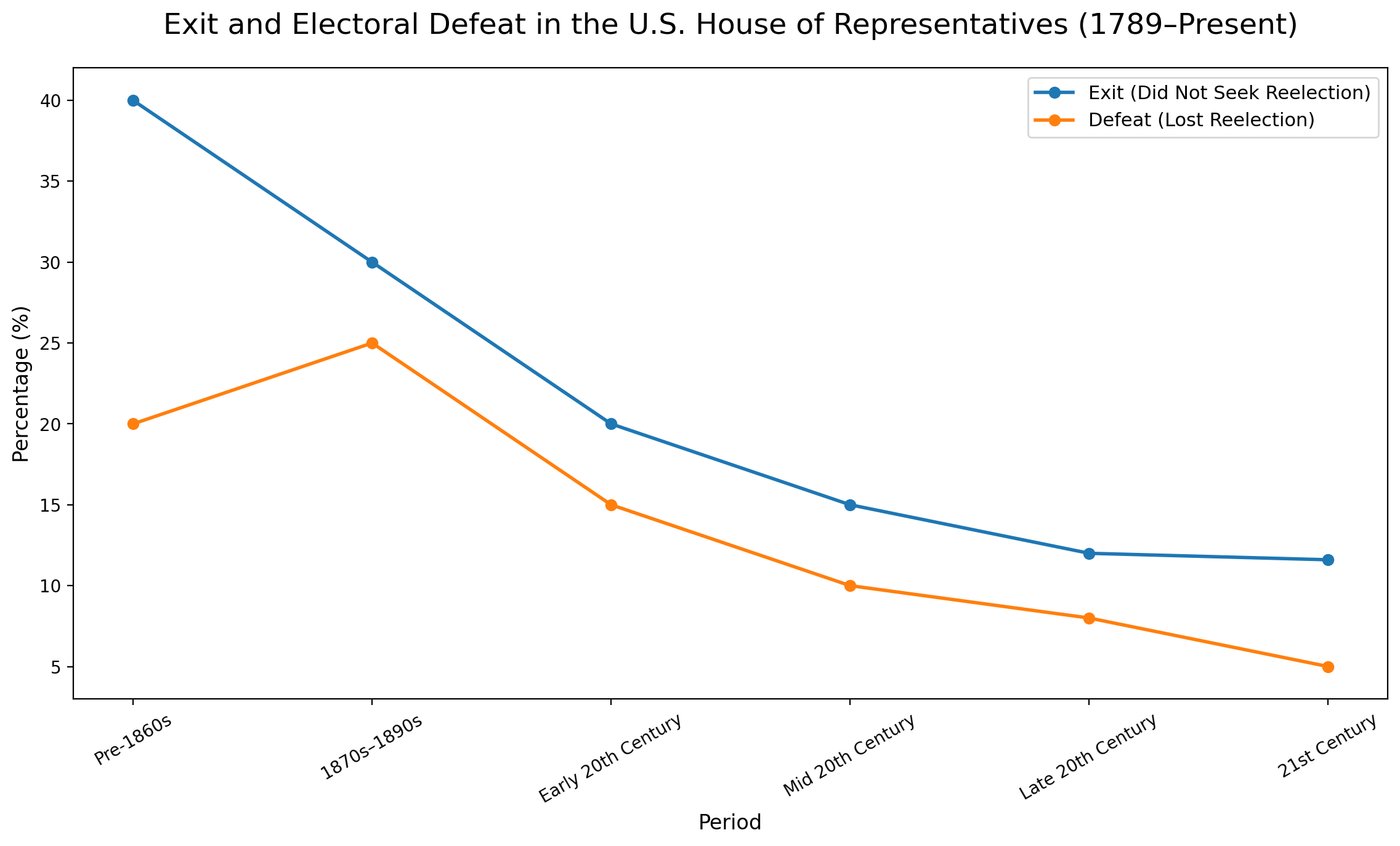
During the 19th century, both channels were active. A substantial share of representatives did not seek reelection, and those who did faced a meaningful probability of defeat. These conditions produced regular replacement across election cycles.
Over time, both channels declined. The proportion of members not seeking reelection fell sharply, and the probability of defeat decreased as reelection success rates increased. In the modern period, both exit and defeat operate at comparatively low levels, reducing the rate of replacement.
As both channels weaken, replacement declines. Elections continue to occur at fixed intervals, but the rate at which officeholders are replaced decreases, and tenure extends across multiple cycles.
Reelection Success and Incumbency Persistence
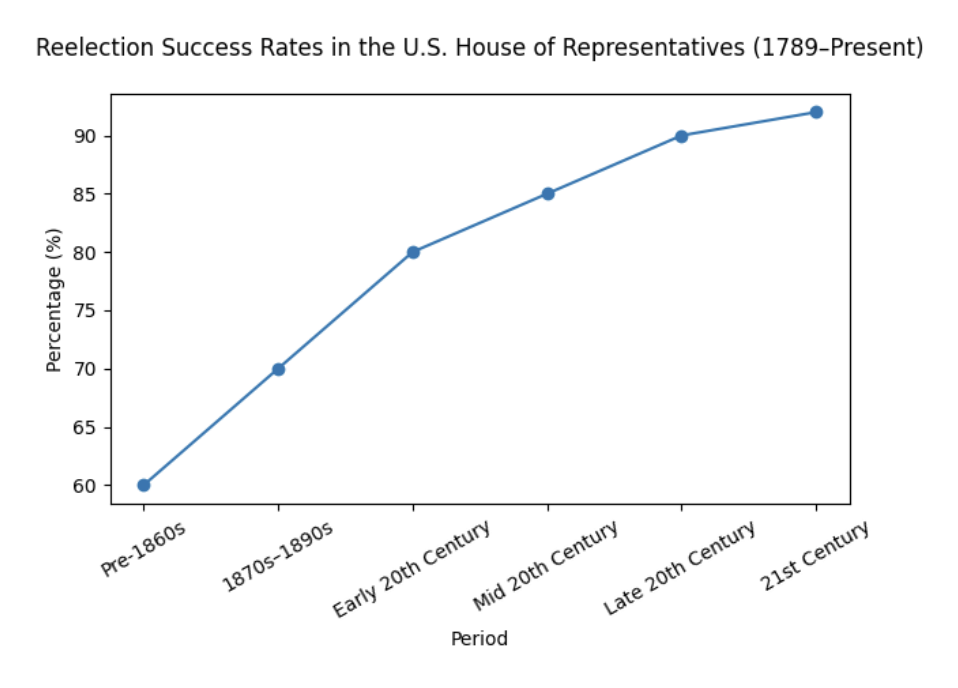
Reelection success rates provide a complementary measure of replacement. As the probability of reelection increases, the probability of electoral defeat correspondingly declines.
In the 19th century, reelection outcomes were more variable, and incumbents faced higher rates of defeat. Over time, reelection success became more consistent. In the modern period, incumbents are returned to office at high rates across most election cycles.
This increase in reelection success functions as a structural counterweight to replacement. As incumbents are returned to office more reliably, the defeat channel contributes less to overall replacement. Combined with reduced voluntary exit, this produces a system in which incumbency persists across successive cycles.
Worked Example — Congressional Replacement, Tenure, and Authority Accumulation
Reelection success rates increased over time in the U.S. House of Representatives, reducing electoral defeat as a channel of change in officeholding and contributing to sustained incumbency across election cycles.
Combined Interpretation
Taken together, these patterns show a consistent shift in the structure of congressional tenure.
Exit declined
Defeat declined
Reelection success increased
As a result, the rate at which membership changes decreased. Replacement did not disappear but became less frequent and less predictable. Elections continued, but the probability of displacement declined.
Under these conditions, tenure extends across multiple election cycles, and replacement becomes less frequent. Replacement becomes dependent on irregular events rather than on routine structural mechanisms.
Relationship to Institutional Structure
These empirical patterns correspond to broader structural dynamics described in the Framework and Emergent System Dynamics.
Where replacement declines, duration accumulates. As duration accumulates, authority becomes unevenly distributed across participants, with longer-serving members acquiring greater influence within institutional processes.
This relationship links observable changes in replacement to the emergence of seniority-based authority structures. The empirical record therefore provides a measurable basis for understanding how reduced replacement contributes to extended tenure and the concentration of institutional authority over time.
Structural Significance
This Worked Example demonstrates that congressional replacement is empirically measurable through voluntary exit and electoral defeat. As both channels weakened, tenure extended across successive election cycles, creating the structural conditions for accumulated institutional authority. The page therefore links observable replacement patterns with broader Framework concepts including duration accumulation, authority distribution, and seniority.
Response Pattern
Replacement Decline
Duration Accumulation
Authority Concentration
This Worked Example applies the Framework to historical congressional service data, illustrating how declining replacement extends tenure and contributes to the accumulation and concentration of institutional authority across successive election cycles.
Emerging Observation — Selective Junior Exit
Recent congressional election cycles have shown increased voluntary retirement among comparatively junior members. If this pattern continues, replacement may become concentrated among members with shorter tenure while longer-serving members remain. Such a distribution would further concentrate seniority-based authority while illustrating an institutional response to existing authority structures.
Sources
Congressional Research Service (CRS), Length of Congressional Service: First Through 118th Congresses (Report R41545), based on analysis of the Biographical Directory of the United States Congress and ICPSR datasets
https://www.congress.gov/crs-product/R41545
Questions for Further Exploration
How do voluntary exit and electoral defeat jointly determine replacement?
Under what conditions does declining replacement contribute to extended tenure?
How does reelection success influence the rate of authority circulation?
At what point does reduced replacement begin to alter institutional authority distribution?
How do replacement patterns contribute to the emergence of seniority?
Which institutional changes appear most closely associated with long-term declines in replacement?
Related Pages
→ Worked Example — The Seniority Ratchet
House replacement patterns provide the empirical conditions through which accumulated tenure develops into seniority-based authority allocation.→ Worked Example — Seniority as a Structural Consequence of Reduced Rotation
Congressional replacement patterns illustrate how declining replacement and extended tenure create the structural conditions for seniority and authority accumulation.→ Worked Example — Congressional Committee-Chair Authority
Committee-chair authority illustrates an institutional manifestation of accumulated tenure and the later redistribution of leadership authority through internal term limits.→ Continuity and Renewal
Congressional replacement patterns illustrate how changing rates of exit and succession redistribute continuity and renewal across successive governing periods.→ Authority and Its Distribution
Extended tenure illustrates the temporal accumulation and concentration of institutional authority.
→ Return to Worked Examples hub
Last updated — August 2026