

A Brief History of Rotation in Office
History Series
A brief history of rotation in office situates the concept within the development of republican government from its earliest recorded forms. Across time, public authority has been granted for defined periods and then returned to the community, establishing rotation as a recurring feature of self-government.
Eligibility determines whether an individual may hold or continue holding an office over time.
Across historical periods, governance systems have continuously negotiated the relationship between continuity and circulation in public authority. Different institutional structures have managed these pressures through varying combinations of eligibility rules, rotation practices, succession mechanisms, civic norms, and authority-duration constraints. The history of rotation in office therefore forms part of a broader historical pattern through which societies organize the continuity, transfer, and renewal of governing authority across time.
Rotation in public office reflects the organization of authority over time. Across civic institutions—juries, magistracies, legislative assemblies, and executive offices—public authority has been entrusted to individuals for bounded periods, shaping who holds office across time and the duration of continuous authority. Across systems, whether authority returns to the community as a practical matter depends on whether service is brought to an endpoint or allowed to continue.
A Brief History of Rotation In Office situates the concept within the development of republican government from its earliest recorded forms. Across time, public authority has been granted for defined periods and then returned to the community, creating the recurring conditions within which rotation, reauthorization, and succession have been structured.
Classical Foundations of Rotation
Rotation in office appears in some of the earliest systems of self-government. In the democratic city-state of Athens, many public offices were filled for limited periods, after which individuals were required to step aside so that other citizens could participate in governance. Aristotle gave this practice a broader civic meaning, describing as a feature of democratic government that citizens “rule and are ruled in turn” (Politics VI.2). His formulation connected rotation with reciprocal participation in governing authority: citizens occupied successive positions as governors and governed within the political community.
This alternation required that authority pass among citizens rather than remain with the same individuals across successive periods. This reciprocity presumes that no individual retains a continuous claim to authority among equals, and that each period of rule concludes before another begins.
The Roman Republic developed similar structural constraints. Magistrates typically served fixed terms of one year, and immediate re-election to the same office was generally discouraged or restricted. These constraints ensured that authority did not remain continuously vested in the same magistrate across successive terms. They helped prevent durable concentration of authority and preserve balance within the constitution of the republic. Polybius situated these practices within a broader constitutional system in which governing authority was distributed among institutions and participants, with each element operating within structures that constrained prolonged concentration (HistoriesVI.19).
Together, these early systems illustrate a recurring institutional principle: authority entrusted to citizens is temporary, and regular replacement helps preserve the self-governing character of the political community.
The Civic Meaning of a Term of Office
Across many republican institutions, the concept of a term has long denoted a temporary grant of public authority. Civic responsibilities such as jury service, magistracies, and other public offices have historically been entrusted to citizens for defined periods and then returned to the community. The bounded duration of these assignments reflects a shared principle of self-government: authority exercised on behalf of the public is temporary rather than permanent.
Jury service in the Anglo-American legal tradition provides a clear illustration. Jurors are temporarily vested with authority to participate in adjudication, including determining questions of fact and rendering verdicts. That authority exists only for the duration of the jury’s service and ends when the proceeding concludes, returning the citizen to private status. The authority is not paused or retained but concludes with the assignment, rather than continuing beyond it.
Similar principles governed many historical offices. In classical republics such as Athens and Rome, magistrates served for defined periods before returning to ordinary civic life. Later republican systems likewise structured public offices around bounded intervals of service. These arrangements reflected the view that public office constituted a temporary civic duty rather than a permanent personal entitlement.
The modern concept of a term of office in representative government continues this tradition. Elections, appointments, and other authorization events confer authority for a defined period, after which that authority returns to the political community. Rotation in office can emerge from this structure of temporary authority, depending on whether service is brought to an endpoint or allowed to continue.
Rotation in European Republican Systems
Later republican polities adopted similar mechanisms. The Venetian Republic applied complex rotation rules across its governing councils and administrative offices. Although political participation was limited to the patrician class, strict rules governing office tenure helped prevent any individual family from monopolizing authority for extended periods (Frederic C. Lane, Venice: A Maritime Republic, 1973). The Venetian constitutional system was also described by republican writers including Gasparo Contarini and Donato Giannotti, whose accounts of its councils, magistracies, selection procedures, and distribution of office became part of the early modern literature through which Venetian institutional practice was studied.
The Adriatic republic of Ragusa, modern Dubrovnik, employed comparable practices. Offices rotated frequently among eligible members of the governing community, limiting the capacity of any individual or faction to accumulate durable authority within the state (Barisa Krekic, Dubrovnik: A Mediterranean Urban Society, 1300–1600, 1997).
Niccolò Machiavelli addressed the related problem of republican durability through recurring renewal. In the Discourses on Livy, he argued that republics endure when their institutions periodically return them to their founding principles and restrain the accumulation of corruption and ambition. His analysis places institutional renewal within the broader problem of preserving republican government through time.
Colonial Experiments in Selection and Succession
The American colonial record contains early experiments in the duration, selection, and renewal of governing authority. The Massachusetts Bay charter of 1629 prescribed annual elections for the governor, deputy governor, and assistants. In 1630, the freemen agreed to choose assistants, who would select the governor and deputy governor from their own membership. The General Court restored selection by the whole court in 1632. By 1634, freemen had delegated legislative business to town deputies while retaining their individual votes in elections of magistrates. These changes redistributed selection authority among the freemen, their representatives, and the magistrates.
In September 1636, Roger Williams described Providence’s developing government in a letter to John Winthrop. Householders met fortnightly and settled common matters by mutual consent. Unmarried men admitted to the settlement sought the voting privileges exercised by householders, revealing an unresolved boundary of political participation. Williams also described a proposal for householders to perform certain duties “by course,” including convening meetings, gathering votes, and overseeing the watch. He had not yet presented the proposal to his neighbors, leaving its adoption to be established from subsequent records.
Connecticut’s Fundamental Orders of 1639 went further in governing individual eligibility. The governor was elected annually, and the Orders prohibited choosing the same person more than once in two years. The provision required an intervening year outside the governorship before renewed eligibility. It converted gubernatorial succession from an electoral possibility into an express eligibility rule.
Providence’s 1640 Plantation Agreement established a different arrangement. The inhabitants chose five disposers to administer common lands, town resources, and general affairs. The disposers were required to submit to a new choice and surrender their accounts quarterly; the clerk submitted to a new choice annually. The agreement prescribed recurring selection and accounting while leaving the eligibility of former officeholders for immediate reselection open.
Rhode Island’s Acts and Orders of 1647 extended the inquiry from town administration to colony-wide government. General matters were to be debated and voted upon in the towns, transmitted through elected committees, and subjected to the prescribed colony-wide decision process. The same proceedings elected Williams an assistant for Providence.
These arrangements preceded Harrington’s Commonwealth of Oceana (1656). They distinguish recurring authorization, delegated selection, succession through election, and compulsory interruption of eligibility. The surviving texts establish the institutional sequence; the question of Harrington’s knowledge of these colonial experiments remains open.
James Harrington gave rotation a systematic place within early modern republican constitutional design. In The Commonwealth of Oceana (1656), Harrington incorporated recurring selection, staggered succession, and intervals of ineligibility into a broader architecture for distributing governing authority and preventing its prolonged concentration. Rotation operated within this design alongside institutional continuity, allowing governing offices and bodies to persist while authority circulated among successive participants.
Rotation in the American Founding Tradition
The American development of rotation included not only limits on time in office, but structured intervals outside office before eligibility could return.
William Penn’s 1682 Frame of Government of Pennsylvania established a staggered Provincial Council. One-third of its members were to leave each year, with incoming members serving three-year terms. After the first seven years, departing councillors would become ineligible for reelection for one full year, allowing other qualified members of the community to acquire experience in the care and burden of government. The revised Frame of 1683 retained this arrangement. Rotation therefore combined staggered succession, bounded service, delayed implementation of a required vacation, and eventual restored eligibility.
Benjamin Franklin carried a similar structure into his proposed Articles of Confederation in 1775. Franklin proposed a continental executive council with staggered three-year terms, one-third of its members changing annually. After completing a three-year term, a councillor would receive a three-year “respite” before becoming eligible again. The proposal joined continuity through staggered succession with a substantial interval of ineligibility before return.
Pennsylvania’s Constitution of 1776 developed the same architecture more extensively. Franklin served as president of the convention that framed the constitution. Its Supreme Executive Council used staggered three-year terms and “continual rotation.” A councillor who served three successive years then became ineligible for four years.
The constitution stated the purposes of this arrangement directly. Rotation would train more citizens in public business, retain within the council members familiar with prior proceedings so that business could be conducted consistently, and prevent the establishment of an “inconvenient aristocracy.” Rotation and continuity were therefore treated as complementary design problems: succession broadened participation while staggered replacement preserved institutional experience.
Pennsylvania also put the principle into practice in its representation at the national level. Delegates representing the state in Congress were selected annually and could be replaced by the General Assembly at any time. No delegate could sit in Congress for more than two successive years, after which the individual became ineligible for reelection for three years. The rule applied first to Pennsylvania’s representation in the Continental Congress and, after ratification of the Articles of Confederation, to its delegates in the Confederation Congress.
The Articles of Confederation subsequently incorporated a related national rule. Delegates were appointed annually, and no person could serve as a delegate for more than three years in any six-year period.
This sequence closely parallels James Harrington’s conception of equal rotation accompanied by “equal vacations.” Rotation was structured through two intervals: time in office and time out of office. The period outside office was not merely an interruption in service. It formed part of the constitutional architecture, creating space for other participants while preserving the possibility that experienced officeholders could later return.
Penn, Franklin’s proposed continental design, Pennsylvania’s 1776 Constitution, and the Articles of Confederation therefore show an early American practice in which bounded service and required absence operated together. Rotation concerned not only when service must end, but also how long authority must remain elsewhere before eligibility returns.
The United States Constitution retained fixed terms and recurring electoral authorization but did not carry forward the mandatory intervals of ineligibility that had appeared in Pennsylvania and the Articles of Confederation. Members of the House were elected every two years (U.S. Const., art. I, § 2), while Senators served six-year terms (U.S. Const., art. I, § 3). At the expiration of each term, authority returned to the electorate for reassignment, but the incumbent remained immediately eligible to receive it again.
Early federal practice nevertheless continued a strong pattern of voluntary rotation and return to private life. The constitutional architecture therefore separated recurring authorization from required succession: terms remained bounded, while the earlier structure of service followed by enforced absence largely disappeared at the federal legislative level.
Washington and the Voluntary Norm of Rotation
George Washington’s voluntary departure from the presidency after two terms in 1797 established a durable precedent that federal executive authority should not remain indefinitely in the same hands. This decision reflected an existing republican understanding that public office was a temporary trust rather than a permanent possession, and that authority ultimately resides with the people.
Primary Source (Farewell Address, 1796)
“Though, in reviewing the incidents of my administration, I am unconscious of intentional error, I am nevertheless too sensible of my defects not to think it probable that I may have committed many errors. Whatever they may be, I fervently beseech the Almighty to avert or mitigate the evils to which they may tend. I shall also carry with me the hope that my country will never cease to view them with indulgence; and that, after forty-five years of my life dedicated to its service with an upright zeal, the faults of incompetent abilities will be consigned to oblivion, as myself must soon be to the mansions of rest.”
— George Washington, Farewell Address (1796)
Interpretation (Structural Context)
Washington’s voluntary departure from office, expressed in the Farewell Address and carried into practice at the conclusion of his second term, illustrates the operation of rotation as a civic norm. Authority is exercised for a defined period and then relinquished, returning to the community without the need for formal limitation.
From Voluntary Rotation to Constitutional Limit: The Presidency
The voluntary precedent established by George Washington remained influential for more than a century, shaping expectations that presidential service would be limited in duration even without a formal rule.
This norm was broken during the presidency of Franklin D. Roosevelt, who was elected to four terms. In response, the Twenty-second Amendment to the United States Constitution was ratified in 1951, establishing a constitutional limit on presidential election eligibility.
This marked a structural shift from a voluntary norm of rotation to a defined constitutional ceiling on repeated electoral authorization. Ordinarily, a person may be elected President no more than twice, with a separate counting rule for substantial service during a term to which another person was elected.
The presidency therefore provides a clear example of a system in which repeated electoral authorization is bounded by a fixed constitutional rule rather than left entirely to electoral outcomes.
Unlike the presidency, Congress operates without term limits → Why Are There No Term Limits for Congress?
The Decline of Informal Rotation and the Emergence of Extended Tenure
In the early Republic, Members of Congress often practiced frequent rotation, returning to private life after short periods of service.
This pattern of limited congressional tenure continued through much of the nineteenth century, as citizen-legislators typically left office after relatively brief service. Congressional Research Service data confirm that extended incumbency remained uncommon until the mid-twentieth century.
As representative institutions expanded in geographic scale, administrative scope, and organizational permanence, continuity in office became more prevalent over time. Longer service increasingly operated within more complex legislative, administrative, and organizational structures.
The mid-twentieth century marked an inflection point in congressional service. Advances in transportation and communication, the professionalization of legislative careers, and changing institutional conditions coincided with the increasing prevalence of extended tenure.
The rise of extended tenure increased the presence of long-serving members within congressional leadership, committee, and seniority structures. As tenure accumulated across successive election cycles, Congress moved further from earlier patterns of frequent replacement.
The average age of Members of Congress has also risen in recent decades, while congressional reelection rates have remained high. Together with longer tenure, these patterns illustrate the increased prevalence of electoral and institutional continuity.
These developments reflect a structural shift in the operation of national governance. The earlier pattern of informal rotation—sustained by custom, expectation, and circumstance—became less common as repeated electoral authorization increasingly produced extended continuity in office.
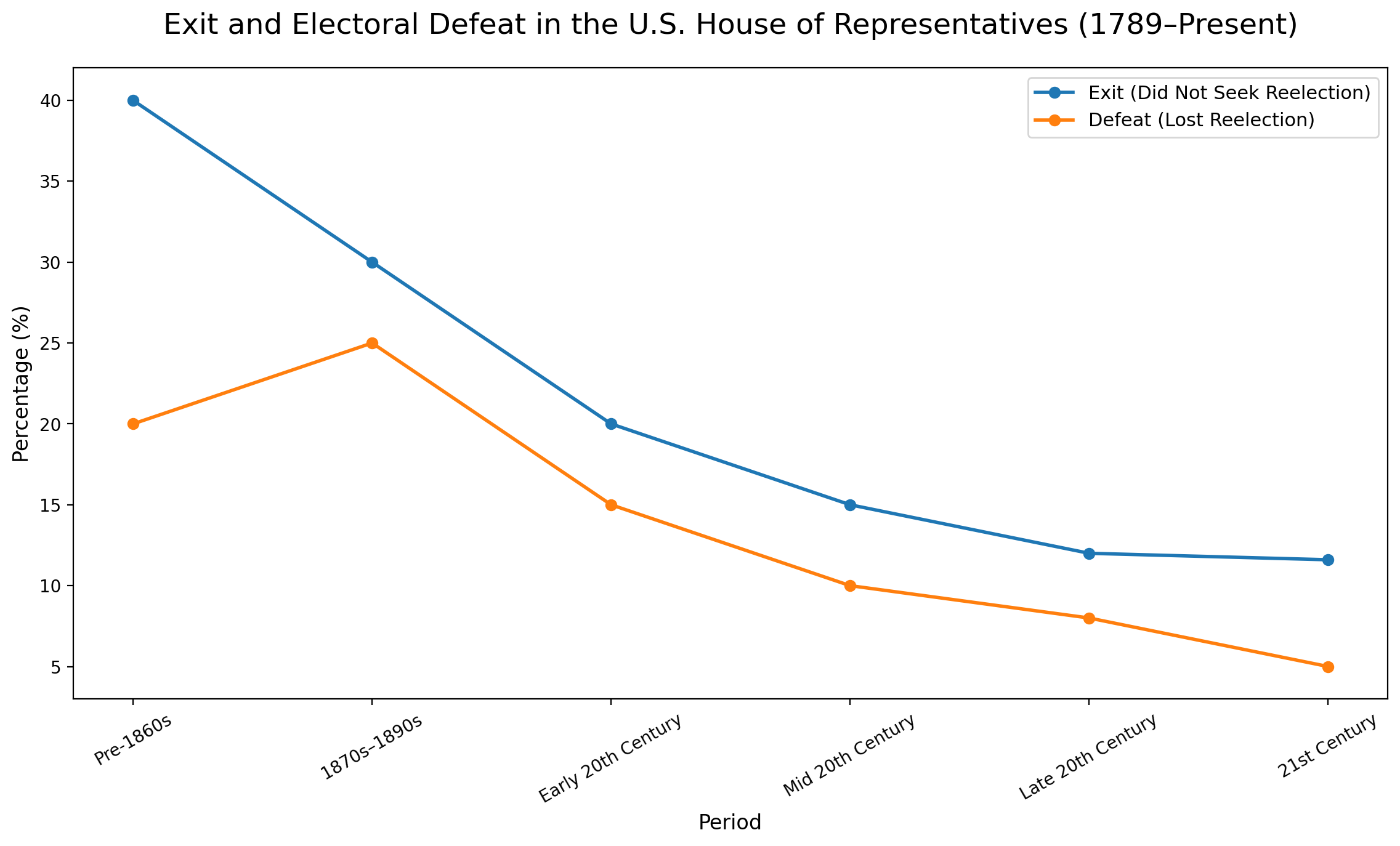
Source: U.S. House of Representatives — Tenure and Exit–Defeat Patterns (Rotation Research).
Rotation and Modern Eligibility Architecture
Modern systems of representative government continue to structure public authority through defined terms of office. Elections confer authority for a fixed duration, after which that authority returns to the political community. This recurring cycle reflects the same underlying principle observed across earlier republican systems: public authority is temporary.
Within this structure, eligibility rules determine whether individuals may continue receiving authorization across successive terms. Lifetime limits can bring eligibility to a non-restorable endpoint. “Consecutive” or Stint-Permission limits require a period out of office before eligibility returns. Open eligibility permits repeated renewal without a prescribed service ceiling.
These architectures produce different relationships among continuity, interruption, succession, and return. Modern analysis therefore distinguishes the expiration of an individual term from the eligibility rules governing whether the same person may receive authority again.
Structural Continuity and the Rotation Principle
Across historical periods and institutional forms, a consistent pattern emerges: public authority is granted for a defined duration and then returned to the community.
These recurring authorization cycles create the conditions within which continuity and succession are structured. Under contemporary Rotation Research usage, rotation in office occurs where eligibility reaches a non-restorable endpoint and succession is required. Historically, rotation also included arrangements in which service ended for a prescribed interval before eligibility could return.
Where eligibility remains continuously open or later restores, authority may return to the same individual. The eligibility architecture therefore determines whether the expiration of a term produces required succession, temporary interruption, or continued renewal.
This provides a basis for examining whether a system supports succession or produces extended continuity in office.
Diagram Concept: Rotation Cycle and Return of Authority
These patterns can be represented as a recurring cycle in which public authority is granted, exercised, and returned to the community.
Conceptual sequence:
Authorization → Term of Office → Expiration of Individual Authorization → Return for Reauthorization → Reauthorization or Replacement
Authorization occurs through an election, appointment, or other formal mechanism that confers authority to an individual for a defined period.
Term of Office defines the bounded interval during which that authorization operates.
Expiration of Individual Authorization marks the conclusion of that defined term.
Return for Reauthorization places authority to select the next officeholder back with the electorate or other authorized selection mechanism.
Reauthorization or Replacement determines whether the same individual receives another period of authority or the office passes to a successor.
These recurring structures illustrate a broader feature of governance systems across time: public authority must continuously negotiate the balance between continuity and circulation. Some systems preserve continuity through open-ended renewal, while others structure authority around defined endpoints, succession practices, or periodic redistribution of governing roles. Rotation in office represents one recurring method through which governance systems manage the duration, renewal, and transfer of authority across institutional time.
Conclusion
The historical record shows that rotation in office has long functioned as a feature of republican governance. From classical systems to modern representative institutions, public office has been organized through bounded periods of individual authorization, followed by succession, reauthorization, required absence, or return to private status. Historically, rotation has depended not only on the presence of defined terms, but on the rules and practices governing what occurs when those terms end.
Over time, the mechanisms supporting rotation have varied. In earlier systems, rotation often operated through formal rules, institutional design, and civic practice. In the American system, rotation has been shaped by the interaction of fixed terms, elections, and evolving eligibility structures.
While the structure of temporary authority remains in place, patterns of continuity and succession depend on how institutional design and electoral conditions shape whether service ends or continues over time.
Questions for Further Exploration
How have different governance systems across history balanced continuity in authority with circulation of office?
Under what conditions do societies favor extended continuity in governance, and under what conditions do they adopt stronger mechanisms of circulation or succession?
What is lost when a system preserves fixed terms and recurring authorization but removes the required period out of office that historically formed part of rotation design?
To what extent have rotation practices historically depended on formal institutional rules as opposed to civic norms, customs, or distributed expectations regarding temporary authority?
How have changes in communication, administration, transportation, and institutional scale altered continuity patterns across representative systems?
How did the rise of long-duration institutional careers change the practical meaning of rotation in office?
How should the concept of rotation distinguish historical systems of recurring circulation and required absence from modern systems of non-restorable eligibility exhaustion?
How do governance systems respond when continuity in office becomes increasingly durable across successive generations or institutional periods?
To what extent do recurring succession mechanisms function as forms of institutional self-correction within long-duration governance systems?
How have evolving legitimacy expectations influenced the ways governance systems organize continuity, succession, and circulation across institutional time?
Related Pages
→ Authority Formation
Continuing development of governing populations and prospective authority across successive governance conditions.→ A Brief History of Time In and Out of Office
Historical development of service boundaries, interruption, restoration, and recurring eligibility through time.→ Authority and Its Distribution
Location, allocation, dependency, and temporal distribution of governing authority.→ Institutional Response Patterns
Recurring institutional responses associated with changing governance conditions and continuity–renewal relationships.→ Rotation Logic
Temporal eligibility architecture, interruption, restoration, exhaustion, succession, and technical Rotation.
Last updated — August 2026