

What Is Rotation in Office?
Rotation in office, in current Rotation Research usage, describes a governance architecture in which an individual’s eligibility to hold office reaches a defined, non-restorable endpoint, requiring succession to another eligible individual.
Rotation is therefore the structural result of non-restorable eligibility exhaustion. The governing rule closes the individual’s pathway to continued or renewed eligibility after the applicable ceiling has been reached.
Historically, rotation had a broader meaning. Republican systems could require departure after a defined period while preserving a later pathway to renewed eligibility following a prescribed period of absence or “vacation.” Rotation therefore could require succession without permanently excluding the former officeholder from future service.
A temporal rule may also require succession in an internal governing role or a change in defined status within continuing officeholding while the underlying office or position continues. Such succession should be distinguished from rotation in the underlying office itself.
Congress operates under conditions of continuing eligibility. No rule establishes a defined, non-restorable endpoint, so positions do not pass by operation of an eligibility rule. This raises a basic question: → Why Are There No Term Limits for Congress?
Rotation and Turnover
A term limit restricts eligibility to serve additional terms in a specified office. The effect of reaching that boundary depends on the eligibility architecture.
In an Endpoint System, eligibility reaches a defined, non-restorable boundary and does not return. In a Stint-Permission Regime, the term limit requires interruption after a defined stint, but eligibility later returns after the applicable restoration condition is satisfied.
A governance system may therefore produce turnover without rotation. It may also require temporary departure and succession while preserving the former officeholder’s future eligibility. A governance system may therefore produce turnover without rotation. It may also require temporary departure and succession while preserving the former officeholder’s future eligibility. Where eligibility later returns under the governing rule, the succession does not constitute rotation under the Rotation Research definition.
See: What Is the Difference Between Turnover and Rotation in Office?
When Rotation Occurs
Rotation occurs when the governing eligibility rule reaches a defined, non-restorable endpoint.
The relevant sequence is:
eligibility remains available within the permitted duration
the governing ceiling is reached
eligibility is exhausted and cannot be restored
succession to another eligible individual is required
Rotation therefore depends on the architecture of eligibility rather than on the mere occurrence of departure or replacement.
Governance systems may preserve a pathway to continued or renewed eligibility.
In a Stint-Permission Regime, a term limit requires departure after a defined stint while later restoring eligibility after the applicable interruption. Other eligibility architectures may also preserve or restore eligibility through sequencing, reentry, or another mechanism established by the governing rule.
Such systems may require departure and succession without producing non-restorable eligibility exhaustion. A former officeholder may later become eligible to return.
The relevant distinction is therefore whether eligibility ultimately reaches a non-restorable endpoint or remains capable of continuing or returning.
See: Do All Term Limits Create Rotation in Office?
Elections Within Rotation
Elections and eligibility rules perform different functions.
Elections determine which eligible individual is authorized to occupy an office. Eligibility architecture determines whether and when an individual remains eligible to continue or return.
Electoral competition can produce turnover under any eligibility architecture. Rotation, in Rotation Research usage, occurs only when the governing eligibility rule reaches a non-restorable endpoint and requires succession to another eligible individual.
Why Rotation Matters
Rotation concerns what happens to governing authority as one period of service gives way to another.
An office or institution may continue for generations while the people occupying it change. Rules governing eligibility help determine whether succession depends entirely on elections and voluntary departure or becomes a recurring feature of the institutional design.
Rotation therefore raises broader questions about succession, continuity, experience, renewal, and the distribution of authority through time.
See: Continuity and Renewal and Authority and Its Distribution.
Rotation Across Institutional Settings
Rotation is a familiar concept across institutions outside political office. Medical trainees rotate through clinical assignments. Military personnel rotate through commands, deployments, and duty stations. Employees in rotational programs move through different organizational functions. Boards and committees rotate members or leadership positions over time.
Across these settings, rotation ordinarily describes structured movement away from a present assignment, position, or responsibility and into a succeeding stage of service. Another participant may take the previous position, or the individual may move onward through a prescribed sequence.
Return may sometimes occur, but it is ordinarily secondary to the rotation itself. The defining event is movement through the institutional sequence.
Historical political rotation generally shared this structure. An officeholder served for a period, departed, and another became responsible for the office; some systems later restored the former officeholder’s eligibility after a prescribed absence.
Modern political usage is more ambiguous. Rules described as producing “rotation” may require only a temporary interruption while preserving repeated future eligibility. Political eligibility analysis therefore requires greater precision about whether a rule produces succession, interruption, restored eligibility, or final eligibility exhaustion.
Historical Context
Rotation has taken different forms across different periods.
Older republican systems often required officeholders to leave after a defined period while allowing them to become eligible again after time away from office. Rotation could therefore include service, departure, succession, a required absence, and eventual return.
Other traditions relied more heavily on voluntary or customary departure. George Washington’s retirement after two presidential terms became an important American example of limited tenure maintained through political practice rather than a formal eligibility rule.
The Twenty-Second Amendment later placed a constitutional restriction on presidential election eligibility, creating a different kind of endpoint.
Beginning in the 1990s, state measures commonly described as term limits revived mandatory departure and succession through a mixture of designs. Many preserved eventual eligibility after time out of office, while others established cumulative or lifetime ceilings.
These different arrangements help explain why rotation has carried different meanings over time and why temporary departure and final exhaustion of eligibility are useful to distinguish today.
See: A Brief History of Rotation II: The Meaning.
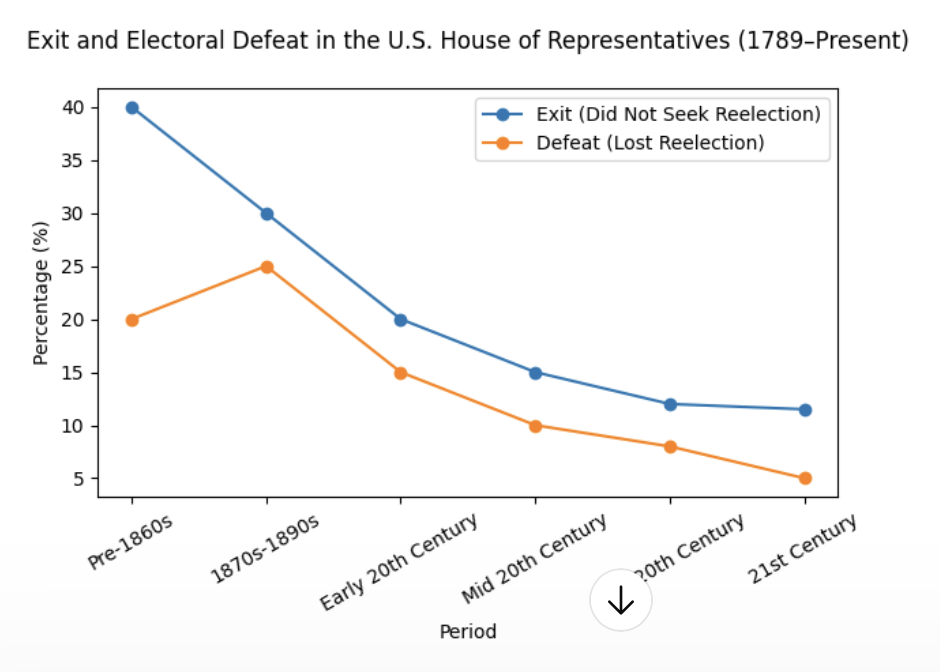
Congress, by contrast, continues to operate without a rule establishing a final eligibility endpoint. Succession therefore depends on retirement, electoral defeat, death, resignation, or other forms of exit rather than on eligibility exhaustion.
Source: U.S. House of Representatives — Tenure and Exit and Defeat Patterns (Rotation Research).
Rotation and Term Limits
In current Rotation Research usage, a term limit places a terminal ceiling on eligibility to hold an office, measured through one or more constituted terms. Once the governing ceiling is reached, eligibility for that office does not return.
Rules conventionally described as “consecutive term limits” operate differently. They constrain authorization across a consecutive sequence of constituted terms, require interruption when the operative ceiling is reached, and later restore eligibility. Rotation Research classifies these as stint-permission limits rather than terminal term limits.
Other temporal constraints may govern authorization to hold an internal governing role or impose a boundary on a defined status while the underlying office or position continues.
Rotation in an office therefore requires more than departure or succession. Under the current Rotation Research definition, rotation occurs when eligibility for the underlying office reaches a non-restorable endpoint requiring succession to another eligible individual.
Where a rule carries the term-limit label, the structural sequence is:
the constituted term → the constrained authorization → the boundary → the endpoint
Where no bounded term of the underlying office or position exists, a temporal rule may instead be a duration constraint on a role, status, or other aspect of continuing officeholding.
These distinctions are examined more fully in What Are Term Limits?, Are These Actually Term Limits?, and Eligibility Regime Architectures.
Questions for Further Exploration
If both temporary ineligibility and final eligibility exhaustion require succession, what changes when the former officeholder remains eligible to return?
If political usage of “rotation” can encompass both temporary interruption and final eligibility exhaustion, how much structural information does the word itself provide without an account of the eligibility pathway?
If two Stint-Permission Regimes require the same departure but impose substantially different periods of absence before eligibility returns, when does recurring succession cease to imply comparable circulation through time?
Can a sufficiently long required absence reproduce some of the structural effects of final eligibility exhaustion while preserving eventual eligibility?
If rotation changes the occupant of an office while surrounding authority, personnel, procedures, and institutional capacity remain continuous, how much renewal can be inferred from rotation in the office alone?
Related Pages
→ What Are Term Limits?
Defines term limits as eligibility rules and distinguishes Endpoint Systems from Stint-Permission Regimes and from other temporal constraints.→ Are These Actually Term Limits?
Tests whether a rule described as a term limit actually constrains eligibility for additional terms in the underlying office or instead limits another authorization, role, or status.→ Rotation Logic
Examines interruption, restoration, succession, repeated eligibility, and non-restorable exhaustion through time.→ Rotation in Office: From Washington to the Twenty-Second Amendment
Examines the movement from customary presidential departure to a formal constitutional eligibility limit.→ State Legislative Term Limits
Provides comparative evidence from the principal modern laboratory of term-limit and rotation architectures.
Last updated — September 2026