

Worked Example — The U.S. Term Limits Amendment Pledge (1996–Present)
Voluntary Constitutional Coordination Through Public Commitment
Following U.S. Term Limits, Inc. v. Thornton (1995) and the congressional term-limit amendment vote sequence of 1995–1996, efforts to establish congressional term limits increasingly included mechanisms operating outside state election administration.
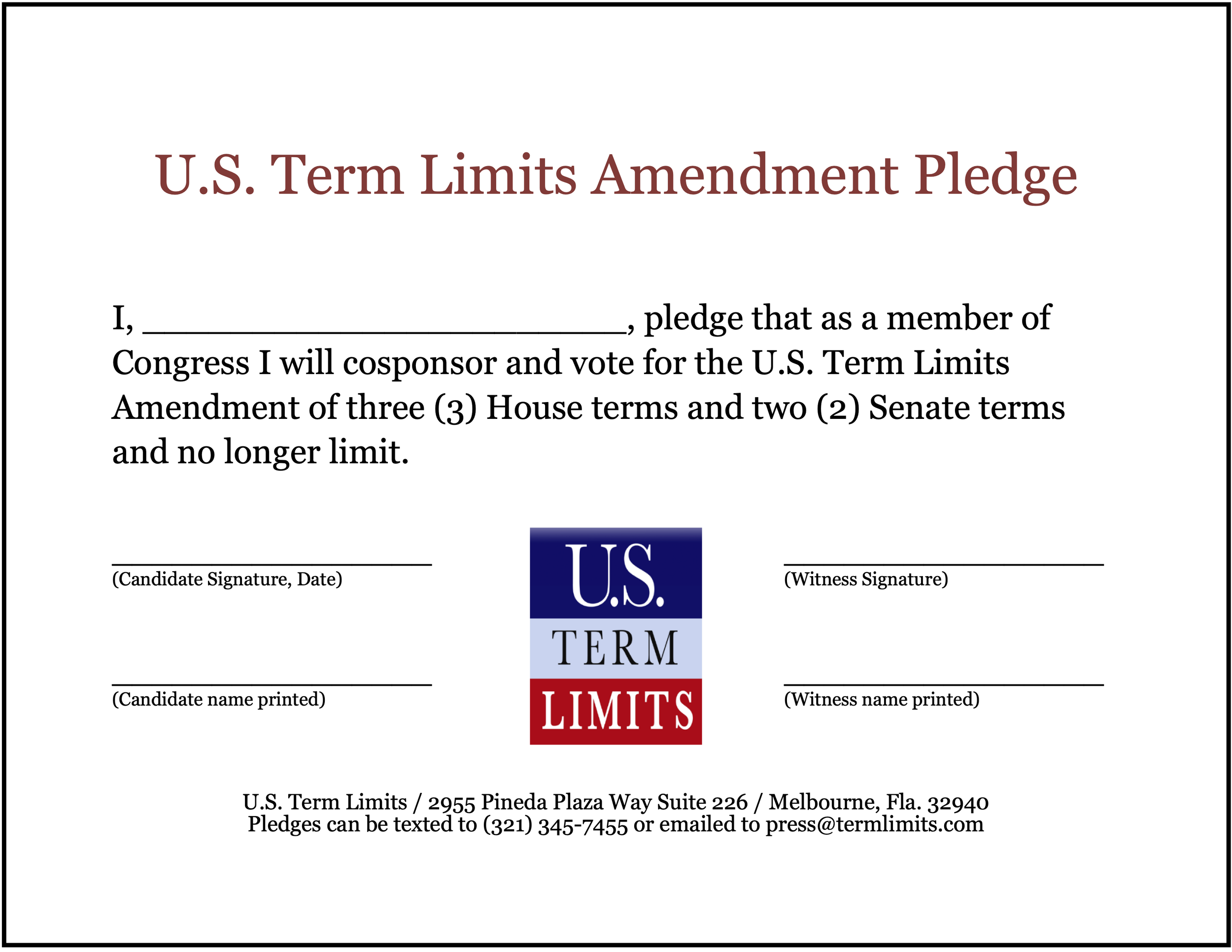
U.S. Term Limits developed the U.S. Term Limits Amendment Pledge as a voluntary candidate commitment. Its public commitment is specific: congressional candidates pledge to cosponsor and vote for a constitutional amendment limiting Members to three House terms and two Senate terms “and no longer limit.” The Pledge has continued to carry that 3/2 amendment standard across successive congressional election cycles.
The Pledge operates through voluntary public commitment by candidates and Members to support a particular congressional term-limit amendment architecture. Its governed object is candidate and Member commitment. U.S. Term Limits privately administers the commitment as a public pledge supporting a specified constitutional amendment.
The Pledge therefore functions as a durable public commitment and amendment-signaling mechanism. Its analytical significance lies in the continued maintenance of the 3/2 “and no longer limit” amendment objective through voluntary political commitment. The Pledge records that public constitutional objective. Other Article V efforts pursued by U.S. Term Limits operate through separate proposal pathways and strategies.
Court and Constitutional Background
Between 1990 and 1994, twenty-three states enacted congressional term-limit measures. Twenty-one were adopted through ballot initiatives and two through state legislative action. U.S. Term Limits, Inc. v. Thornton (1995) foreclosed these state-administered mechanisms as a means of imposing additional qualifications for congressional service.
Congressional amendment consideration occurred during the same institutional transition. The House considered competing constitutional term-limit proposals in March 1995, before Thornton was decided, while the Senate proceeded separately into 1996. As examined in the preceding Worked Example, the two chambers never assembled a common Article V amendment pathway.
Following Thornton, the 1996 ballot measures generally pressed federal legislators toward a specified 3/2 congressional term-limit amendment and, in most states, also instructed state legislators to support applications to Congress to call an Article V Convention to call an Article V Convention for proposing the specified congressional term-limit amendment. Ballot notation and related electoral consequences supplied an additional pressure layer around those constitutional instructions. Later Article V and Elections Clause decisions differentiated the permissible forms of legislative direction and state-authored ballot enforcement.
The U.S. Term Limits Amendment Pledge operated through voluntary candidate commitment administered privately by U.S. Term Limits. This mechanism maintained the 3/2 amendment objective through public commitment while state eligibility law and state-administered ballot consequences occupied separate institutional pathways.
Framework Classification
Voluntary Public Commitment Mechanism
Governed Object
Candidate and Member commitment to a specified congressional term-limit amendment.
Mechanism
Candidates voluntarily commit, if elected, to cosponsor and vote for the U.S. Term Limits Amendment establishing three House terms and two Senate terms “and no longer limit.”
Administration
U.S. Term Limits privately administers and records the commitment.
Institutional Function
Public constitutional-amendment signaling and longitudinal recording of support for the 3/2 amendment standard.
Legal Effect
The Pledge creates a voluntary political commitment. Eligibility, ballot access, ballot notation, and amendment procedure continue under their respective governing constitutional and election-law architectures.
| Constitutional Pathway Migration Sequence | |||||
|---|---|---|---|---|---|
| Mechanism | State-administered | State-imposed legal rule | Ballot-linked | Eligibility effect | Constitutional status |
| State-enacted congressional term-limit measures (1990–1995) | Yes | Yes | Sometimes | Direct | Foreclosed by Thornton |
| Voter instruction / ballot notation + subject-specific Article V Convention instruction (1996–2000) | Yes | Yes | Yes | None | Article V and Elections Clause boundaries later limited direction and enforcement mechanisms |
| USTL congressional Amendment Pledge (1996–Present) | No | No | No | None | Private voluntary commitment |
Facsimile of a current U.S. Term Limits Amendment Pledge form for congressional candidates.
The U.S. Term Limits Amendment Pledge
The durable feature of the U.S. Term Limits Amendment Pledge is its public amendment architecture. Across successive congressional cycles, U.S. Term Limits has continued to ask candidates and Members to support a constitutional amendment limiting service to three House terms and two Senate terms “and no longer limit,” while the documentary form of the commitment has evolved.
The documentary form of the commitment has changed over time. A U.S. Term Limits archival account identifies an original pledge signed by Senate candidate Susan Collins on April 15, 1996, as a two-part commitment: support for a constitutional term-limits amendment and a separate commitment to leave the Senate after two terms. U.S. Term Limits subsequently discontinued the self-limit component; current congressional Amendment Pledge forms focus on cosponsoring and voting for the institutional 3/2 amendment.
This distinction clarifies the continuity being measured. The Pledge preserves the stated 3/2 amendment objective as the surrounding form and organizational strategy change. It therefore provides a longitudinal public record of continued commitment to that amendment objective.
Repeated circulation also exposes successive candidate cohorts to a standardized congressional term-limit proposal and creates a persistent mechanism for publicly recording support for that proposal. USTL continues to publish signer information and to solicit the Amendment Pledge from congressional candidates.
The Pledge specifies support for a constitutional amendment limiting Members to three House terms and two Senate terms “and no longer limit” as its public constitutional commitment. Transition treatment, proposal pathway, and implementation provisions remain design variables of the amendment-development process.
| Constitutional Architecture Comparison | ||
|---|---|---|
| Period | Primary mechanism | Constitutional status |
| 1990–1995 | State-administered congressional term-limit systems | Foreclosed by Thornton |
| 1995–1996 | Congressional amendment proceedings | Article V congressional proposal route |
| 1996–2000 | Voter instruction toward congressional proposal and, in most states, state-legislative Convention applications; ballot-interface mechanisms | Article V and Elections Clause boundaries later limited direction and enforcement mechanisms |
| 1996–Present | Voluntary congressional pledge architecture | Private voluntary commitment |
| 2016–Present | Single-subject state-legislative Convention applications | Article V Convention-application pathway |
Congressional Amendment Dynamics
The U.S. Term Limits Amendment Pledge dentifies support for a specific congressional term-limit standard: three House terms and two Senate terms “and no longer limit.”
Within the congressional proposal pathway under Article V, each Pledge signature records a public commitment by a candidate or Member to support the specified 3/2 amendment. Across successive congressional cycles, the Pledge therefore provides a longitudinal record of individual commitments to that amendment standard. An operative congressional proposal requires additional institutional conditions: chamber identity around a common amendment text and the constitutionally required two-thirds vote in each House.
The Pledge is therefore analytically useful as evidence of continued public maintenance of the 3/2 amendment objective. Subsequent constitutional strategies pursued by U.S. Term Limits have their own design variables, proposal pathways, and implementation choices. The congressional Pledge supplies evidence of continuity in the publicly stated 3/2 amendment objective across those strategic changes.
Relationship to Article V Application Efforts
The congressional Amendment Pledge emerged alongside a broader 1996 strategy directed toward constitutional proposal. Most 1996 ballot measures paired pressure on federal legislators to support the specified 3/2 amendment with voter instruction directing state legislators toward applications for an Article V Convention to propose that congressional term-limit amendment.
U.S. Term Limits later developed a separate voluntary pledge directed to candidates and Members of state legislatures. That Article V pledge asks state legislators to support a Convention application for congressional term limits.
The two pledge systems use the same broad mechanism of voluntary public commitment while addressing different institutional actors and stages of constitutional action. The congressional Amendment Pledge commits candidates and Members of Congress to support the specified 3/2 amendment. The state-legislator Article V pledge records commitment to advance the Convention-application pathway.
The 1996 ballot measures provide an earlier, distinct form of popular authorization surrounding that state-legislative pathway. The later Article V pledge and application campaign proceed through voluntary candidate commitment and direct legislative action rather than reproducing the antecedent statewide voter-authorization stage.
Structural Significance
The U.S. Term Limits Amendment Pledge maintains a specified congressional term-limit objective through repeated voluntary candidate and Member commitments across successive constitutional strategies.
State-enacted congressional term-limit measures operated directly on eligibility and were foreclosed by Thornton. Ballot-instruction and ballot-notation systems later used state election machinery to influence congressional action and encountered constitutional limitation in Cook. The Amendment Pledge uses privately administered voluntary commitment to preserve a public record of support for the specified 3/2 amendment objective.
Its long-duration significance lies in the continuity of a specified public commitment across changing constitutional strategies. Candidates and Members continued to encounter and adopt the 3/2 “and no longer limit” commitment while congressional proposal, voter-backed pressure on both Article V proposal routes, ballot-interface mechanisms, and later direct state-legislative Convention-application campaigns developed around the same constitutional objective.
The broader sequence includes:
state-enacted congressional term-limit measures,
congressional amendment consideration,
voter-backed pressure on both Article V proposal routes,
ballot-instruction and ballot-notation mechanisms,
voluntary congressional amendment commitments,
and later direct state-legislative Convention-application coordination.
These mechanisms occupy distinct positions within the constitutional process. State-enacted limits governed eligibility; congressional and Convention pathways govern constitutional proposal; ballot-interface systems govern voter-facing election information; and voluntary pledges govern public commitments by candidates or officeholders.
These mechanisms occupy distinct positions within the constitutional process. State-enacted limits govern eligibility, ballot-interface systems govern voter-facing election information, and voluntary pledges govern public commitments by candidates or officeholders.
The Pledge provides a longitudinal control for the stated 3/2 amendment objective. Its recurring use records continuity in that public commitment across changes in constitutional pathway, organizational strategy, and implementation design.
Questions for Further Exploration
How can a stable 3/2 public commitment persist across successive congressional cycles while the institutional strategies used to pursue it continue to change?
How can substantial growth in the number of Pledge signers coexist with the absence of an operative bicameral coalition capable of proposing the pledged amendment?
If candidates voluntarily commit themselves to support a constitutional rule that would later constrain congressional eligibility, what does that reveal about the relationship between electoral authorization and institutional self-limitation?
How can a privately administered pledge generate durable constitutional pressure while possessing no legal authority over congressional eligibility, ballot access, or amendment procedure?
If the Pledge preserves the same 3/2 amendment objective across successive cycles, how can proposal pathway, sequencing, and implementation strategy change while the publicly stated commitment remains stable?
How can continuity in a public constitutional commitment coexist with substantial flexibility in the institutional strategy used to pursue it?
If Congress controls one of the constitutional pathways for proposing the amendment that would constrain its own members, how does voluntary candidate commitment interact with congressional proposal authority?
How can the same 3/2 commitment function simultaneously as an electoral signal, a constitutional objective, and a longitudinal record of continuity across successive reform strategies?
How does the congressional Amendment Pledge relate to the broader 1996 strategy in which the same 3/2 objective was advanced through voter pressure on congressional proposal and, in most states, voter instruction toward state-legislative Convention applications?
If the publicly maintained 3/2 commitment persists while surrounding constitutional strategies change, what evidence would establish that the underlying amendment objective itself had changed?
Related Pages
→ Worked Example — Canonical House Three-Term Rotation Design
Examines the House component of the 3/2 commitment maintained by the congressional Pledge and develops its eligibility design.→ Worked Example — Congressional Term-Limit Amendment Vote Sequence (1995–1996)
Traces the congressional amendment sequence that immediately preceded the Pledge and establishes the bicameral setting in which the continuing 3/2 commitment emerged.→ Worked Example — U.S. Term Limits, Inc. v. Thornton (1995)
Establishes the constitutional foreclosure of state-created congressional term limits that increased the importance of amendment-oriented coordination.→ Worked Example — Institutional Response Sequence to Congressional Term-Limit Initiatives (1990–2001)
Places the Pledge within the broader sequence of state eligibility measures, congressional amendment consideration, voter-backed pressure on both Article V proposal routes, ballot-interface mechanisms, and voluntary constitutional coordination.→ Article V Response to Congressional Term-Limit Initiatives
Examines the congressional and Convention proposal routes, the voter-backed Article V strategy embedded in most 1996 measures, and the later direct state-legislative application campaigns.
← Previous
Congressional Term-Limit Amendment Vote Sequence (1995–1996)
Next →
Colorado Amendment 18 (1998)
→ Return to Worked Examples hub
Last updated — October 2026